


In Women’s Program, Pianist Takes
Center Stage
By David Weininger
Globe Correspondent / February 9, 2009
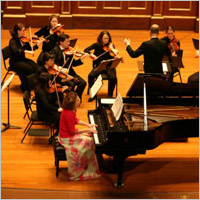
She and the 14-member string ensemble opened with “Partita” by Vítezlava Kaprálová. Born in Brno, she was a student of the Czech composer Bohuslav Martinu and trained as a conductor with Charles Munch in Paris. “Partita” is written in a traditional tonal language shot through with striking dissonances, somewhat reminiscent of Hindemith. It’s constructed like a Baroque concerto, with piano and strings in a back-and-forth dialogue. The outer movements are driven, with a strong sense of contrapuntal movement. The central slow movement is dreamy and reflective, with darker forces threatening to steal in and disturb the hard-won calm.
This was the East Coast premiere of the piece, and it is eminently worth hearing again. Eskin’s playing was a marvel of poise and balance, and the long, rippling melodies in the slow movement were transfixing.
Libby Larsen’s String Symphony, the longest work of the evening, offered an enlightening contrast. The first two movements are slow, and instead of Kaprálová’s strongly defined contrasts, one heard music that seemed to wander, full of languid statements and ambiguous harmony. The finale was more energetic and featured some varied textures and complex rhythms.
Eskin returned for the concert’s finale, Liszt’s early, rarely performed “Malédiction” for piano and strings. In addition to the expected virtuoso pyrotechnics, there are some unexpectedly daring harmonies, as well as traces of the mature composer’s ability to transfigure a musical idea into its opposite. Still, its most notable aspect is the flashy solo part, one that Eskin handled with surprising ease.
“You’re not supposed to like Liszt,” the pianist chided as she returned for an encore—a reference, most likely, to his status as the concert’s token male. The encore was a thoroughly enjoyable rag called “Pickles and Peppers,” written in 1906 by American composer Adaline Shepherd.
Under David Feltner’s able if undemonstrative conducting, the ensemble’s playing was spirited and engaging; it lacked a certain level of polish, though, and the intonation was at times insecure. Still, the orchestra deserves credit for putting on an exceptional and imaginative program.