
American Artist Andrew Wyeth Dies
at Age 91
By Mark Feeney
Globe Staff / January 16, 2009
...Continues from page 1. Rothko added, however, Mr. Wyeth “is not whole as [Edward] Hopper is whole.” The comparison was not gratuituous. In its prevailing air of human isolation, Mr. Wyeth’s work bears an obvious kinship to that of Hopper, who was a friend. Hopper is one of three artists whose work can be seen as, in a sense, triangulating with Mr. Wyeth’s. The others are Winslow Homer, with his restrained palette; and Norman Rockwell, with his easy accessibility and tendency to nostalgize.
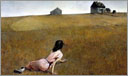
Such an anomalous group suggests how difficult it can be to assess Mr. Wyeth’s work. It’s notable that the owner of “Christina’s World” is New York’s Museum of Modern Art, the most influential institution in the 20th-century art world.
As for Mr. Wyeth’s allegiance to representation (and not an especially innovative form of representation), he once declared, “I’m a pure abstractionist in my thought.”
The youngest of five children, Andrew Newell Wyeth was born on July 12, 1917, in Chadds Ford. His parents were Newell Converse Wyeth and Carolyn (Bockius) Wyeth. His father had moved to Chadds Ford to work with the celebrated illustrator Howard Pyle.
A frail child, Mr. Wyeth left school just two weeks into first grade. He received the rest of his education at home. Mr. Wyeth’s art teacher was his father, and he’d spend hours drawing and doing watercolors. “I played alone, and wandered a great deal over the hills, painting watercolors that literally exploded, slapdash over my pages, and drew in pencil or pen and ink in a wild and undisciplined manner,” he said in a 1976 interview with the Metropolitan Museum of Art’s Thomas Hoving.
The Wyeth family spent their summers in Needham, where N.C. Wyeth had been born. They began to go to Port Clyde, Maine, when Mr. Wyeth was 10. Mr. Wyeth once described the look of Maine as “all dried bones and dessicated sinews.” In 1998, the Farnsworth Center for the Wyeth Family in Maine opened at the Farnsworth Art Museum in Rockland, Maine.
Specializing in watercolors and landscapes, Mr. Wyeth had his his first one-man exhibition in 1937, when he was 20. He met Betsy Merle James on his birthday, in 1939. They married a year later. That same day in 1939, she introduced Mr. Wyeth to her friend, Christina Olson.
Along with her brother, Alvaro, Olson would become one of Mr. Wyeth’s favorite models. Their Pennsylvania counterparts were a farming couple, Karl and Anna Kuerner.
Mr. Wyeth’s painting of Christina Olson, unable to walk because of a childhood bout with polio, crawling through the fields toward her 18th-century farmhouse, would sell for $ 1,800 and become one of the most reproduced images of the last century. Now the property of the Farnsworth Museum, the Olson farm was put on the National Register of Historic Places in 1995. It’s the only site placed on the list for being the subject of an artwork.
The death of Mr. Wyeth’s father, in an automobile accident in 1945, marked a major personal and professional transition in his life. “When he died, I was just a clever watercolorist—lots of swish and swash,” Mr. Wyeth said in a 1965 Life magazine interview. “I had always had this great emotion toward the landscape, and so, with his death ... the landscape took on a meaning—the quality of him.”
One of Mr. Wyeth’s best-known images is “Winter 1946,” a tempera showing a boy racing down a hill. On the other side of that hill was the railroad crossing where his father had died.
Mr. Wyeth had always been intensely private, which made the brouhaha surrounding the paintings of Testorf all the more striking. Not even Betsy Wyeth had known of their existence. Asked what they were about, she gave a one-word answer, “Love.” Was her answer born of jealousy—or calculation? That answer, combined with Wyeth’s secretiveness and Testorf’s ripely Nordic sensuality, lent a not-so-faint whiff of sexual scandal to the news.
Mr. Wyeth sold 240 renderings of Testorf in 1986 to a Pennsylvania businessman for $ 6 million. In 1990, the businessman sold the paintings for an estimated $ 45 million.
“What the Helga?” a 1986 New Republic headline asked. The next year, the paintings began a lengthy museum tour, including a stop at the Museum of Fine Arts, in 1988. It opened at the National Gallery, in Washington, where Mr. Wyeth became the first living American artist to have an exhibition. In 1980, he had become the first living American artist to have an exhibition at London’s Royal Academy.
Mr. Wyeth received the gold medal for painting of the National Institute for Arts and Letters in 1965. In 1977, he became the first American painter since John Singer Sargent to be inducted into the French Academy of Fine Arts.
President George W. Bush awarded him the National Arts Medal in 2007.
“All I can say at the end of my life is that painting has been my one interest, nothing else but art,” he told The Philadelphia Inquirer in 1997.
In addition to his wife and son Jamie, Mr. Wyeth leaves another son, Nicholas, an art dealer, of Cushing; and a granddaughter.
Funeral plans were not immediately announced.