


American Artist Andrew Wyeth Dies
at Age 91
By Mark Feeney
Globe Staff / January 16, 2009
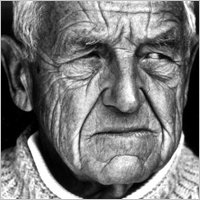
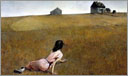
Andrew Wyeth, whose evocations of a timeless rural present along the Maine coast and in Pennsylvania farm country made him America’s most popular living artist and whose 1948 painting “Christina’s World” became one of the most famous artworks of the 20th century, died today.
Wyeth, who was 91, died in his sleep in his home in Chadds Ford, Pa., after a brief illness, the Brandywine River Museum said in a statement. Perhaps no American painter has ever had as strong a hold on the popular imagination as Mr. Wyeth did over the course of his seven-decade career. As the critic Brian O’Doherty once noted, “Wyeth communicates with his audience, numbered in millions, with an ease and fluency that amounts to a kind of genius.”
One mark of Mr. Wyeth’s special status is how often he was summoned to the White House. He was the first artist to receive the nation’s highest civilian honor, the Presidential Medal of Freedom, in 1963. Richard Nixon held an exhibition of his paintings and dinner in his honor in 1970. In 1990, he was the first artist to receive the Congressional Gold Medal. President George H.W. Bush, presenting the award, noted that Mr. Wyeth’s work “caught the heart of America.”
Yet Mr. Wyeth’s popularity never translated into critical acclaim. Although rarely dismissed outright, Mr. Wyeth was seen as a peripheral figure, at best, and an artistic anachronism. “They are just sort of colored drawings,” the critic Hilton Kramer once wrote of Mr. Wyeth’s paintings, “illustrated dreams that enable people who don’t like art to fantasize about not living in the twentieth century.”
Mr. Wyeth’s shaky standing with the art establishment was underscored in 1986 when it was revealed he had spent 15 years secretly painting a neighbor, Helga Testorf. News of “the Helga Paintings” made the covers of both Time and Newsweek. Time’s art critic, Robert Hughes, voiced the art-world consensus when he mocked “the great Helga hype” and dismissed the resulting exhibition of the artworks as “an avalanche of Styrofoam and saccharin.”
Mr. Wyeth was the most famous member of one of America’s most renowned artistic families: His father, N.C. Wyeth was a noted muralist and book illustrator; his son, Jamie, is a highly regarded realist painter.
Jamie Wyeth once likened his father’s work to that of the poet Robert Frost. “At one level, it’s all snowy woods and stone walls. At another, it’s terrifying. He exists at both levels. He is a very odd painter.”
Much of that oddness had to do with a kind of self-imposed mutedness: of tonality, emotion, subject. Mr. Wyeth once described his approach to art as “seeing a lot in nothing.” There is a sense of almost-palpable restraint to his work, of a sought-after narrowing of visual possibility.
That narrowing begins with locale. All of his work is set in the vicinity of two places: Chadds Ford, where Mr. Wyeth was born, grew up, and as an adult lived seven months of the year; and Cushing, Maine, where for most of his life he summered. (Mr. Wyeth later moved nearby, to Benner Island.) Other than a trip to France and England in 1977, he never left the United States, and only rarely did he venture beyond “Wyeth country” at home.
Mr. Wyeth painted in a consistently dry, austere style. Starting in the 1940s, he preferred to paint in tempera, a process that suspends pigments in egg yolk rather than oil. Tempera, he once said, allowed him to avoid painting “a picture that looks like a painting. People who like the paint surface don’t understand what I’m doing.”
There was nothing excessive or inessential in Mr. Wyeth’s work. He strove for an almost-mannered simplicity. The mythic emerges from the specific in his work. “I’ve often said, ‘If I was really good, I could have done the field in “Christina’s World” without her in there.’ The less you have in a subject, the better the picture is, really.”
In form as well as content, Mr. Wyeth’s painting is unemphatic, uninflected, even-toned. “My work is very subdued in color,” he said in a 1997 interview with CBS’ “Sunday Morning,” noting his fondness for earth tones. Both visually and spiritually, his temperas and watercolors are the painterly equivalent of sepia-toned photography: His barns and fields and no-tech interiors provide a pre-patinated sense of the past.
This pairing of ostensible contemporaneity with seeming distance in time helps account for the unsettling quality Mr. Wyeth’s work can often possess. The Abstract Expressionist painter Mark Rothko once remarked, “Wyeth is about the pursuit of strangeness.” Continued...